
These scores are an outgrowth of Mary Oleskiewicz’s lifelong study and performance of Quantz’s music. Beginning as a graduate student at Duke University and then throughout her professional career, she assembled a nearly complete collection of electronic scans and paper copies of manuscript and early printed sources for all of Quantz’s compositions, as well as related works by his contemporaries and colleagues.
Mary’s dissertation included editions of seven sonatas by Quantz. Published editions followed of seven trio sonatas (A-R Editions, 2001) and the six flute quartets (Steglein Publishing, 2004). I began making the first of the present editions for use in our performances and recordings. Many more were subsequently created to aid her research, and during her last years she decided to make them available publicly through free online publication. Although the edition is mainly my work, it has been made possible by the untold hours that Mary spent identifying and examining sources, ordering copies from libraries, and gathering them together in neatly organized storage bins and electronic folders. The edition gives the scores in formats decided jointly with Mary, and they reflect our experience of playing all of Quantz’s instrumental music from the original sources on flute and keyboard.
Basic matter on the sources and on Quantz’s notation is summarized below. Issues of performance practice, instrumentation, attribution, and chronology in this repertory were subjects of Mary’s research throughout her career. Although she did not live to publish all of her findings, I hope to incorporate them into a book now in progress.
Editorial Guidelines
The great majority of Quantz’s compositions are preserved in accurate manuscript copies prepared under his direction for the Prussian king Frederick II “the Great.” These are preserved in the Königliche Hausmusik (KHM) section of the German State Library (Deutsche Stadtsbibliothek) in Berlin. A number of manuscripts removed from Berlin during World War II are now in the Russian National Library in St. Petersburg. Manuscripts of other works, especially the trio sonatas and some early concertos, are preserved in the Saxon State Library (Sächsische Landesbibliothek) in Dresden. Several dozen solo, duo, and trio sonatas are also extant in eighteenth-century printed editions.
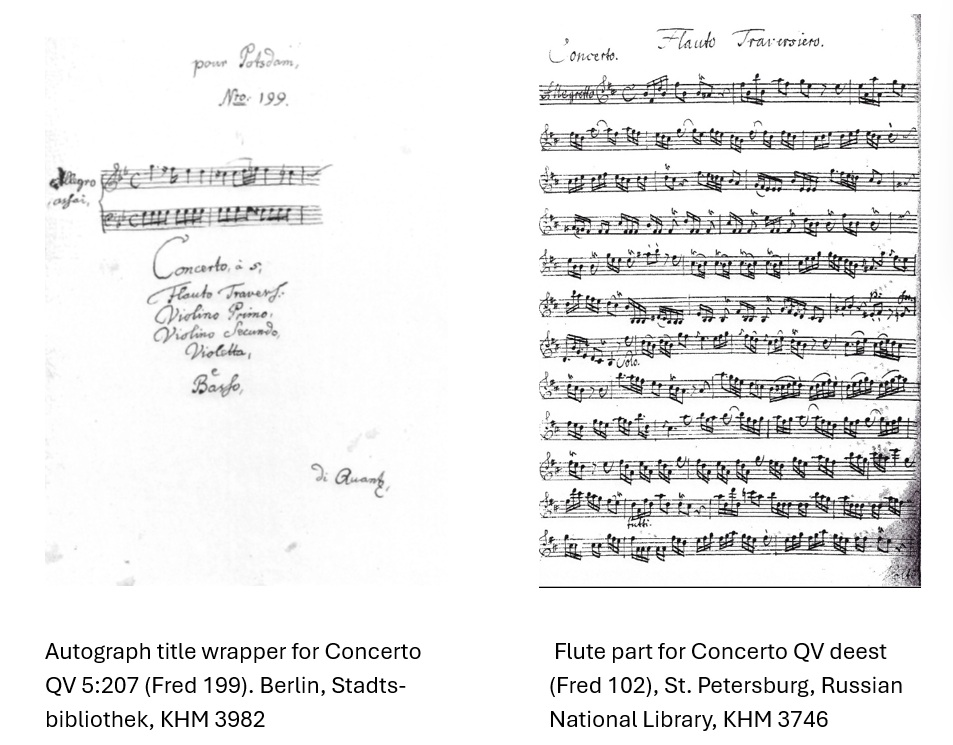
The KHM contains two or three nearly identical copies for most works. The edition generally follows one of these, but where necessary other sources have been consulted, especially for early compositions. For works not in the KHM, an effort has been made to evaluate all extant sources. In the relatively rare instances where a reading is uncertain or was altered or corrected in a source, this is reported in a footnote within the score, or in a separate editorial commentary. A footnote on the first page of each score generally identifies the principal source and directs the reader to a separate commentary where one has been prepared.
The original notation is close enough to modern practice that only a few idiosyncracies require comment (see below). The edition normally follows the principal source with respect to the beaming of small note values and other details. Editorial additions are placed in square brackets except in the case of accidentals, which are set above the relevant note in all but the bass line. Slurs, dynamics, and other such markings are added only on the basis of parallel passages or doubling parts. Emendations of notes, rests, and other features are described in footnotes.
The sources often give fermatas at the ends of movements. The edition omits these, as most of these fermatas are artifacts of a notational convention followed in eigheenth-century scores: the final ritornello of a movement is not written out but is signified by a Da capo (or Dal segno) indication, with a fermata indicating the end of the ritornello.
The format of this edition was chosen to facilitate online publication and on-demand printing by individual users. The score format is designed for double-sided printing on American-sized sheets (8.5 x 11 inches), with as few page-turns as possible.
Idiosyncracies of the sources
The KHM collection contains the majority of Quantz’s sonatas for flute and bass (continuo) and nearly all of his concertos. Manuscripts of the sonatas give these in score; each concerto is preserved in parts: one for the solo flute, one each for violins and viola, and two for the bass. One of the bass parts, usually labeled Basso, is figured; the other, designated Basso ripieno, lacks figures and typically includes only those passages played by the tutti (chiefly ritornellos). The precise instrumentation of these parts probably varied depending on the venue of a performance, as did the presence of any doubling (ripieno) players of the upper string parts.
In tutti passages, the flute part usually doubles the first violin; these doublings are shown in the edition, although they were probably not meant to be played. In slow movements the flute part is written on two staves, with the bass or other lowest sounding part written on the lower stave (without figures). These bass lines, intended to guide the soloist in improvised embellishment, are not included in the edition. The solo part rarely contains indications for cadenzas, which Quantz allowed only in the first two movements of a three-movement concerto. But fermatas (indicating the possibility of a cadenza) appear in many Basso parts, sometimes as later additions to the original manuscript.
In the edition, the two bass parts are both given on the bottom line. The dropping out of the Basso ripieno in solo passages is indicated by “−bs. rip.,” its re-entrance by “+ bs. rip.” Where they diverge, these parts are indicated by “bs.” and “bs. rip.,” respectively. At such points there is sometimes a “p” (piano) marking for the Basso that coincides with the last note of the Basso ripieno, still presumably playing forte. In such cases the edition silently shifts the “p” marking for the Basso onto the following note
Thirty-five concertos, mostly composed toward the end of Quantz’s career, include bassoon parts. With one exception, the bassoon part is for the second (slow) movement only. The bassoon sometimes replaced an original viola part, for which a substitute viola part was created. The presence of a bassoon part is indicated in a footnote on the opening page of the score, and where necessary an appendix gives the alternative form of the second movement (with bassoon and substitute viola part).
Several groups of sources that were once parts of the KHM are no longer in Berlin. Two series of concertos are missing: Fred nos. 48–64 and 163–176. A few works from the first of these series survive in other sources. A third series, nos. 100–124, is extant in St. Petersburg. An unknown number of other works once in the KHM were apparently discarded as part of a culling of the collection during the 1760s. Among these were all of Quantz’s trio sonatas, the six quartets, and many sonatas for flute and continuo. As a result, the earliest sonata retained in the collection is the one numbered 88. The other known works are extant in Dresden and elsewhere, and in early printed editions.
Extracts from the flute parts of certain sonatas and concertos are included in a manuscript collection known as the Solfeggi. Now in Denmark, the latter was apparently assembled by Quantz or one of his students. The edition identifies passages in the concertos that also appear in the Solfeggi, as well as other passages that are set off by crayon markings in the manuscript flute parts, apparently to signal that they were to receive special attention during practicing.
Idiosyncracies of Quantz’s notation
Ties and slurs. Quantz usually omitted ties when these fall on pairs of notes that are also under slurs. The edition follows this convention.
Accidentals. In principle, Quantz’s accidentals applied only to the immediately following note. Thus the sources often repeat accidentals when the same pitch recurs within a measure, contrary to modern practice. On the other hand, an accidental remained in effect in the following measure when a pitch is immediately repeated after a bar line. In early works, moreover, Quantz rarely used natural signs, employing a flat to cancel a sharp and vice versa. The edition modernizes the treatment of accidentals; in cases of doubt, editorial accidentals are set above notes (within brackets in bass parts).
Triplets. Quantz rarely marked triplets explicitly (with “3”), Instead triplets must be recognized by groupings of notes beamed in threes, as Quantz explained in his Essay on Playing the Flute (Versuch einer Anweisung die flöte traversiere zu spielen, Berlin, 1752; English translation by Edward Reilly, On Playing the Flute, 2d edn., New York: Schirmer Books, 1985). The edition usually retains “3” markings where they occur in the sources.
Staccato dots and strokes. Many of Quantz’s later works distinguish between staccato strokes and dots, as discussed in his Essay, but copyists did not always make the distinction clear. In earlier works, moreover, Quantz probably used only sign which can appear as either a stroke or a dot in manuscript copies and early printed editions. The edition shows dots only where their presence in the principal source is clear; strokes appear in the sources as short vertical lines but are represented in the edition by the modern wedge-shaped symbol. The edition supplements missing staccato signs (in brackets) only where they are absent from parallel passages or doubling parts.
Ornaments. Quantz probably never used ornament signs, only the abbreviation “tr.” This nevertheless could signify any of the various ornaments described in his Essay. The edition refrains from interpreting “tr” signs and supplements them (in brackets) only where they are absent from parallel passages or doubling parts.
Appoggiaturas. The edition reproduces the notation of small notes (petites notes) as found in the principal source, even where the written values of these notes are inconsistent between parallel passages or unison doublings. The edition likewise follows the sources in the use of slurs joining appoggiaturas to their main notes, regardless of any inconsistencies. Quantz gives instructions for the interpretation of small notes in his Essay, but especially in his early works he does not appear to have followed his own prescriptions.
Chords and multiple stops. The sources usually show chords in the string parts with each note on a separate upward stem. Only the top pitch is shown with its full note value, in accordance with eighteenth-century performance practice. The edition follows this notation. Very rarely, chords also occur in solo passages for the flute; presumably these were arpeggiated in the same manner as multiple stops for the strings by placing the lowest note on the beat, and breaking the chord upward one note at a time.
Dynamics. Quantz’s earliest works contain only “p” (piano) and “f” (forte) markings, if any, but dynamic indications grow more frequent and more varied in later compositions. Quantz never used explicit indications for crescendo or decrescendo, but these are sometimes implied by closely spaced “p” and “f” markings in later works. Sudden accents can also be indicated by closely spaced “f” and “p” on a single note; this occurs especially on dissonant chords played by the strings while accomanying solo passages.
Fingering. No examples have been found of fingering numerals in flute parts. Fingering indications do occur very rarely in parts for the violins, especially where figuration in small note values requires quick string crossings (bariolage). These numerals are included in the edition, usually with an explanatory footnote.
David Schulenberg
Dec. 18, 2025