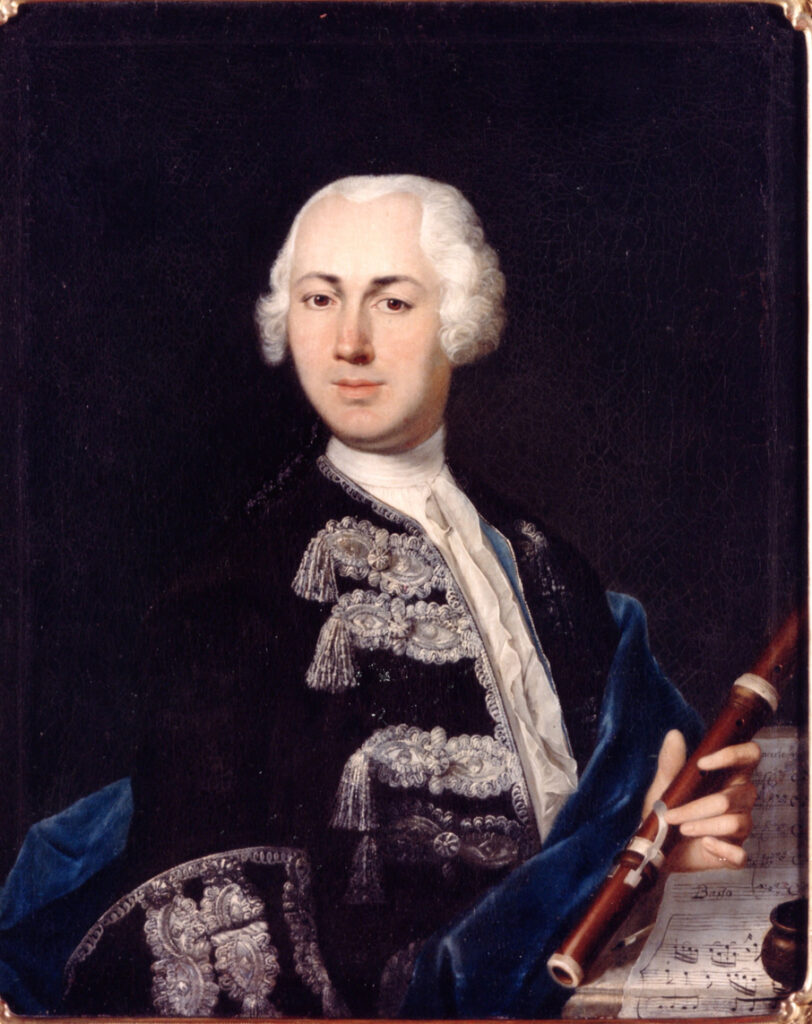
Portrait of Quantz by Johann Friedrich Gerhard, ca. 1735 (Bayreuth, Neues Schloss)
This webpage is a portal into the music of Johann Joachim Quantz (1697–1773), the leading composer of music for the flute in eighteenth-century Europe. He was also an innovator in flute design and performance technique and author of one of the most important books documenting eighteenth-century European performance practice. A younger contemporary of Bach, Handel, and Vivaldi, Quantz composed some five hundred sonatas and concertos for the flute that remain largely unexplored, chiefly due to the inaccessibility of all but a handful of these works. Quantz was also an influential teacher whose most famous pupil, King Frederick II “the Great” of Prussia, was himself a composer and flutist as well as one of the most important patrons of music in eighteenth-century Europe.
The purpose of this website is to make Quantz’s music available to all. Scores and audio files of his works will be published here as they are prepared. For access to the available editions, click here for a spreadsheet containing links to scores and, for some works, recordings. A guide to the spreadsheet follows immediately. Please read further below for additional information about Quantz and this website. This link takes you to some details about the editions themselves: editorial guidelines, sources, and notation.
Latest addition: pieces for unaccompanied flute (QV 3:1.1-21)
Accessing the Quantz editions through the spreadsheet
The spreadsheet, which is planned eventually to list all of Quantz’s music, uses the word link to indicate available editions. These are listed in the order given by Horst Augsbach in his thematic catalog of the composer’s works. The first three columns give titles and keys (“b” in column 3 signifies “flat,” as in “B-flat major”; “m” signifies the minor mode). Columns 4 and 5 give Augsbach’s “QV” numbers, which take the form 1:1, where the first number represents a category: 1 for solo flute works; 2 for trio sonatas; 3 for flute trios; 4, 5, and 6 for concertos. For many of these works the spreadsheet also gives a “Fred” number in column 6, corresponding with the number attached to the work in lists of pieces whose manuscript copies were in the collection of King Frederick.
Column 7 indicates the type of source used for the edition: dates for eighteenth-century publications, library abbreviations for manuscripts. Works with “Fred” numbers are preserved in the KHM (Königliche Hausmusik) section of the German State Library (Deutsche Stadtsbibliothek) in Berlin. The five “Edition” columns give links to scores, flute parts, and realizations of the figured bass (basso continuo part) where available. For some works, recordings are also available, for others only synthesized audio files; both types of files are linked in the “audio” column. The “crit. comm.” column indicates the availability of critical commentaries, that is scholarly evaluations of the sources, alternate versions of the music (where present), and other matters. Those interested in obtaining additional performing parts are invited to contact the present writer (schulenberg.david@gmail.com).
The origin of this website
The leading researcher and authority on the music and flutes of Quantz was the American musician and scholar Mary Oleskiewicz (1966–2025). She devoted her career to studying and performing the music of Quantz and those around him, including King Frederick. In a life cut short by cancer, Mary revived the techniques required for proper performance on Quantz’s unique flutes; identified his authentic compositions and established their chronology; and discovered, published, and recorded previously unknown or unavailable works by the composer, notably his six quartets for flute, strings, and basso continuo.
In addition to commissioning and playing precise copies of Quantz’s flutes, Mary gathered copies and scans of the hundreds of eighteenth-century manuscripts and printed collections preserving not only Quantz’s complete works but flute music by his colleagues, including King Frederick, Carl Philipp Emanuel Bach (second son of Johann Sebastian Bach), the Graun brothers Carl Heinrich and Johann Gottlieb, and many less well-known figures such as Blochwitz, Braun, and Buffardin. Her early death prevented her from fulfilling plans to edit and record much of this music, and to write the book that would have rought together her most important findings about Quantz and his music.
This website makes available a portion of Mary’s legacy. Quantz wrote some three hundred concertos for flute, strings, and continuo; close to two hundred sonatas for one flute and continuo, and dozens of trio sonatas and other works. The trio sonatas are particularly well represented in modern editions, but these are among Quantz’s earliest compositions, and some of those published under his name are not in fact his. The solo sonatas are less well represented in print, but as many of these are becoming available in highly legible online scans of early sources, this category of compositions has not warranted high priority for publication here. The concertos, on the other hand, are not only the most numerous but the least accessible of Quantz’s works, as they are preserved chiefly in manuscript parts, not scores. As they are the most important and most varied of Quantz’s compositions, they are the chief current focus of this project.
Initial priority nevertheless has been given to publishing scores of the sonatas and concertos that Mary recorded, as listeners may wish to play these compositions themselves. Among these is Quantz’s best-known work, the G-major concerto QV 5:174 (Fred no. 161), which Mary performed in one of her last recordings. Together with the present writer she played through every one of Quantz’s concertos and sonatas, identifying works that are notable for one reason or another. Among these are compositions that seemed exceptionally expressive, dramatic, or otherwise distinctive musically. But there were other reasons for assigning high priority to certain compositions. Among these are twenty-five concertos whose KHM sources were removed from Germany during World War II and are now in Russia. Thirty-five concertos with bassoon parts formed another interesting (and little-known) group. As Mary’s scholarly work included sorting genuine from spurious works attributed to Quantz, we also created scores of trios and concertos of uncertain authorship, including several concertos likely to be otherwise unknown compositions by King Frederick.
In closing, a word on the status of these editions as “critical” editions. More detailed information about the sources and the music will be published elsewhere. Here it suffices to say that for most works a formal critical commentary, with detailed description of the sources and lists of variant readings, is unnecessary. The KHM manuscripts, which preserve the great majority of Quantz’s compositions, were prepared under the composer’s direct supervision and are remarkably accurate. Where multiple copies of individual works are preserved within this collection, they typically give nearly identical texts. Hence most of the editions are based on a single one of these manuscripts, identified in a footnote at the beginning of the score. The few errors and variants within the source used for the edition can usually be reported adequately in footnotes within the individual scores.
Critical commentaries are provided in special cases, including the famous G-major concerto QV 5:174. This work is preserved in a greater number of manuscript sources than usual, and two of these contain autograph corrections or revisions; previous editions have not consulted all the available manuscript sources or correctly identified all of their copyists. Therefore a separate critical commentary is provided for this work and for other exceptional compositions. Further information about this music and its sources will be found in the book that I am now writing, working from the notes and publications that Mary left as her legacy to the musical world.
David Schulenberg
February 14, 2026